The World Cup fever has gripped the monks of Tibet as well! A recent newspaper report says that at Tibet’s holiest shrine, young monks are getting up at 3 a.m. – not to pray, but to watch the World Cup matches.
Lights flickered in the windows of the Potala Palace, former home of the Dalai Lama, as France beat Portugal this week to set up a final showdown on Sunday, 9th July, 2006, against Italy. It was reported that the monks watched on a 54-cm colour TV, drinking Coca Cola and eating instant noodles.
Lobsang, a 27 year old monk said, “ I get very excited, very happy, when I watch the games because I get to see a lot of the famous players.” Like many of the 83 monks at the Palace, Lobsang goes by only one name.
Tibet’s Buddhist monks are not encouraged to play soccer, though they are allowed to watch.
All this, of course, is a long way from the time when Lhasa was known as the Forbidden City and hardly anyone had seen the Potala Palace, let alone the Dalai Lama. But then, this is the 21st century!
Sunday, July 09, 2006


Monday, June 05, 2006
ONE FOR THE ROAD
My son recently sent me a link to the following news item which I found most interesting. It will certainly appeal to those thirsting for adventure. I reproduce the item in toto (well, almost) from the website which anyone interested can visit at: http://www.indianarc.com/
THE WORLD'S MOST BIZARRE MOTOR SPORT- ENDURANCE AUTORICKSHAW RACING, Aug 21-28, 2006
THE WORLD'S MOST BIZARRE MOTOR SPORT- ENDURANCE AUTORICKSHAW RACING, Aug 21-28, 2006
Be part of history and don't miss the birth of a new motorsport. The Indian Autorickshaw Challenge is a 1000km (590 miles) rally through the most scenic roads of southern India in a three-wheeled motorized vehicle. The race is open to everyone regardless of experience, nationality, and age. The organizers will provide rickshaws. You'll have 2 days to prepare your vehicle before the start.
Friday, June 02, 2006
A REMARKABLE PHOTOGRAPH
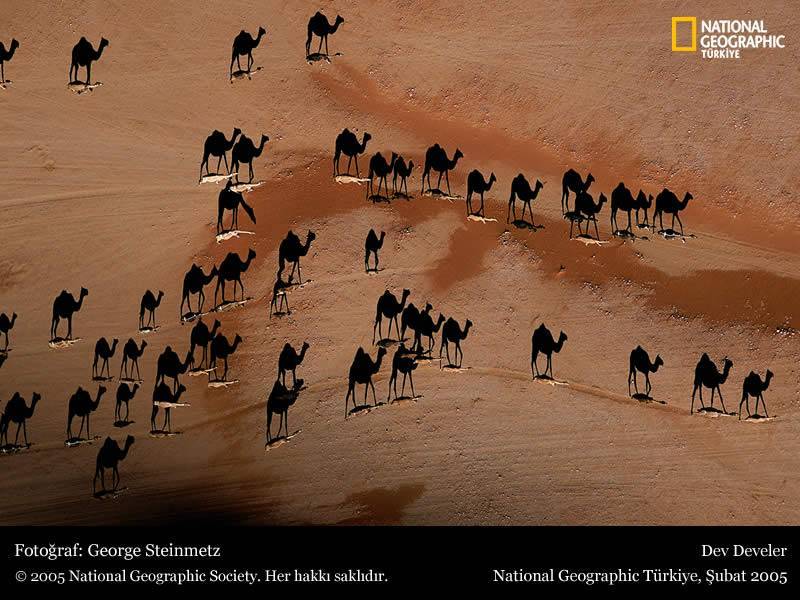 If you look at this picture very carefully, you can notice that Black ones are shadows, white ones are the real camels... The snap has been taken from above......... Simply unbelievable!
Wednesday, May 24, 2006
FIFTY YEARS OF INDIAN IMMIGRATION TO THE USA
Fifty Years Ago.
Did you know that the quota existing for Indian immigrants to the USA in 1954-55 was only 100 per year! A newspaper report says that, the number of Indians migrating to the USA between July 1, 1954 and June 30, 1955 was 116, inclusive of 33 persons who entered that country as non-immigrants and whose status was later adjusted to that of immigrants. This point was discussed in the Lok Sabha on May 22, 1956. One of the members asked the concerned minister whether India proposed to move the US for a ‘little increase in this quota’. The minister replied, ‘As far as we know, even this quota of 100 is not filled up every year’!
Read on for the current situation………
With Mexico being the undisputed Numero Uno in immigration to the United States, both legal and illegal, the battle rages on for claiming second place honors for the coveted Numero Dos award. And the current leader is—India.The Department of Homeland Security (DHS) and its Office of Immigration Statistics (OIS) in the USA keep tabs on immigration statistics with their annual yearbooks released at the end of each fiscal year. The latest offering from September, 2004, shows India winning the battle for second place in naturalized American citizens. [Yearbook of immigration statistics for 2003 -- PDF, page 134]:
“Mexico was the leading country of birth for persons naturalizing in 2003, accounting for 56,093 new citizens. Other major countries of birth for persons naturalizing in 2003 were India (29,790), the Philippines (29,081) Vietnam (25,995), the People’s Republic of China (24,014). . .”
Source: http://www.vdare.com/mann/050228_indians.htm
Saturday, May 13, 2006


Friday, May 12, 2006
THE INDUSTRIAL SCENE IN INDIA - A HUNDRED YEARS AGO
I found the following details from a most unlikely source – the ‘Prabuddha Bharata’ magazine published by the Ramakrishna Mission! Here are the facts, selected from the issue dated May, 1906:
Breweries: 23, Cotton mills: 132, Distilleries: 20, Flour mills: 34, Ice factories: 47, Ironworks: 28, Jute mills:34, Mica works: 12, Oil mills: 56, Paper mills: 10, Potteries: 13, Rice mills(including those of Burma): 26, Saw mills: 28, Silk factories: 16, Sugar factories: 17, Tanneries: 17 Tobacco factories: 11, Woolen mills: 7.
Well, at least we had some industries back in 1906!
Thursday, April 27, 2006
MISCELLANY
THE GOOD SAMARITAN
In these days of the ubiquitous bottled drinking water, the following news item published recently in the ‘Hindu’ made me blink:
From a Railway Board circular of 1956 directing “Authorities of all railway stations in the country to look out for philanthropic gentlemen in their respective localities who will volunteer to supply drinking water during summer to passengers travelling by trains. The railway authorities will supply them with utensils for the purpose.”
ILL WIND
From a newspaper report:
The Dutch police have confiscated the saxophone of a busker who played so badly his audience complained. He performed at the railway station at Leiden, and had been reportedly told to leave.
Friday, April 07, 2006
Monday, March 27, 2006
Sunday, January 08, 2006
FIRST WOMAN AT THE WHEEL
We all know that Karl Benz was the inventor of the automobile. However, it is not so widely known that, until August 1, 1888, nobody, including Karl Benz, had made a long-distance journey by car. The credit for that goes to his intrepid wife, Bertha Benz. This is the story of a drive Bertha embarked upon, the first time that anyone drove more than 25 miles.
Bertha had been very supportive of her husband’s efforts in developing a ‘horseless carriage’ ever since they were engaged. However, much to her frustration, her husband never risked taking the car too far out of Mannheim, where they lived. Bertha knew that to project the pioneering self-propelled vehicle as a viable alternative to the horse-drawn carts and carriages of the day, it had to demonstrate its capability over long distances.
So, on that fateful morning in August, Bertha, 43, then a mother of four, left a note that she was going to Pforzheim where her mother lived. She took her sons, Eugen, 15 and Richard, 14, with her. What she did not mention in the note was that she would be travelling in Karl’s three-wheeled car. Not wishing to wake Karl up, the trio pushed the car out of Benz’s workshop-cum-garage and beyond the block before starting the raucous 1660 cc, 2.5 hp(at 500 rpm) single-cylinder engine. And so they set off for Pforzheim. But there was a glitch; they didn’t know the way.
They travelled across the Neckar river to Weinheim. From there, they steered south to Heidelberg. The simple cooling system of the car required topping up with water every now and then. The carburettor doubled as a fuel tank too, but could only hold 4.5 litres of ‘ligroin’(a petroleum distillate used as a solvent), on which the car ran. By the time they reached Wiesloch, via Heidelberg, they were very low on fuel.
To buy ligroin, Bertha stopped at the local ‘Apotheke’, or chemist’s shop, which can justifiably claim to be the first filling station in the world. They took more supplies at the towns of Langenbrucken and Bruschal and continued to Durlach. At one point, the fuel line became blocked, so Bertha removed the obstruction with her hatpin. An ignition fire also short-circuited, so she made an insulator out of one of her garters. The ingenuity of the fairer sex! From Durlach, they turned into the hilly Black Forest region. That is when the inadequacy of the car’s two-speed, belt-driven gearing system became apparent. The lower gear was just not adequate enough to take it up the inclines. The solution was simple: two of them got out and pushed, while one steered.
After cresting the hill, it was time to descend. The block brakes working only on the rear wheels just about managed to slow the car down, but the brakes wore off pretty fast. So Bertha stopped by at a cobbler’s to get the blocks lined with leather. By sundown, they arrived at Pforzheim, having covered 62.5 miles(100 km), or about half their round trip. Bertha had made her point.
Mercedes-Benz is still doing rather well.
[ Sources: An article by Abhijit Mitra, Business World, Jan. 9, 2006 and the website: www.autoland.am]Saturday, October 08, 2005
THE INTERNET IN AMERICA
Everyone's on the Internet in America. Right? Wrong! A recent report in The Hindu says that one in five Americans say they've never used the web and a third say they don't even use the Web occasionally, according to a new survey conducted by the non-profit Pew Internet & American Life Project. There is also a significant digital divide between those who use and don't use the Internet, especialy when it comes to race and income. About 70% of white Americans use the Internet, compared to about 57% of African-Americans, according to the survey.
Friday, October 07, 2005
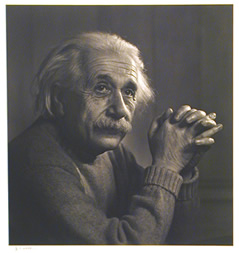
THE WORLD AS I SEE IT - AN ESSAY BY EINSTEIN
Recently I came across this abridged version of an essay by Albert Einstein. It has moved me greatly. Some of it is pure Vedanta. Perhaps that's why it rang a bell somewhere within me. The essay is very simple, beautiful and touches your heart. I would like to share it with all those who read my blog.
"How strange is the lot of us mortals! Each of us is here for a brief sojourn; for what purpose he knows not, though he sometimes thinks he senses it. But without deeper reflection one knows from daily life that one exists for other people -- first of all for those upon whose smiles and well-being our own happiness is wholly dependent, and then for the many, unknown to us, to whose destinies we are bound by the ties of sympathy. A hundred times every day I remind myself that my inner and outer life are based on the labors of other men, living and dead, and that I must exert myself in order to give in the same measure as I have received and am still receiving...”
"I have never looked upon ease and happiness as ends in themselves -- this critical basis I call the ideal of a pigsty. The ideals that have lighted my way, and time after time have given me new courage to face life cheerfully, have been Kindness, Beauty, and Truth. Without the sense of kinship with men of like mind, without the occupation with the objective world, the eternally unattainable in the field of art and scientific endeavors, life would have seemed empty to me. The trite objects of human efforts -- possessions, outward success, luxury -- have always seemed to me contemptible.”
"My passionate sense of social justice and social responsibility has always contrasted oddly with my pronounced lack of need for direct contact with other human beings and human communities. I am truly a 'lone traveler' and have never belonged to my country, my home, my friends, or even my immediate family, with my whole heart; in the face of all these ties, I have never lost a sense of distance and a need for solitude..."
"My political ideal is democracy. Let every man be respected as an individual and no man idolized. It is an irony of fate that I myself have been the recipient of excessive admiration and reverence from my fellow-beings, through no fault, and no merit, of my own. The cause of this may well be the desire, unattainable for many, to understand the few ideas to which I have with my feeble powers attained through ceaseless struggle. I am quite aware that for any organization to reach its goals, one man must do the thinking and directing and generally bear the responsibility. But the led must not be coerced, they must be able to choose their leader. In my opinion, an autocratic system of coercion soon degenerates; force attracts men of low morality... The really valuable thing in the pageant of human life seems to me not the political state, but the creative, sentient individual, the personality; it alone creates the noble and the
sublime, while the herd as such remains dull in thought and dull in feeling.”
"This topic brings me to that worst outcrop of herd life, the military system, which I abhor...This plague-spot of civilization ought to be abolished with all possible speed. Heroism on command, senseless violence, and all the loathsome nonsense that goes by the name of patriotism -- how passionately I hate them!”
"The most beautiful experience we can have is the mysterious. It is the fundamental emotion that stands at the cradle of true art and true science. Whoever does not know it and can no longer wonder, no longer marvel, is as good as dead, and his eyes are dimmed. It was the experience of mystery -- even if mixed with fear -- that engendered religion. A knowledge of the existence of something we cannot penetrate, our perceptions of the profoundest reason and the most radiant beauty, which only in their most primitive forms are accessible to our minds: it is this knowledge and this emotion that constitute true religiosity. In this sense, and only this sense, I am a deeply religious man... I am satisfied with the mystery of life's eternity and with a knowledge, a sense, of the marvelous structure of existence -- as well as the humble attempt to understand even a tiny portion of the Reason that manifests itself in nature."
SOURCE ACKNOWLEDGEMENT
· Source : http://www.aip.org/history/einstein/essay.htm
· The text of Albert Einstein's copyrighted essay, "The World As I See It," was shortened for the above web exhibit.
Saturday, August 13, 2005
MORE TRIVIA
AMAZING FACTS....
*Coca-Cola was originally green.*The most common name in the world is Mohammed.*The names of all the continents end with the same letter that they start with.*The strongest muscle in the body is the tongue.*TYPEWRITER is the longest word that can be made using the letters only on one row of the keyboard.*Women blink nearly twice as much as men!!*You can't kill yourself by holding your breath.*It is impossible to lick your elbow.*People say "Bless you" when you sneeze because when you sneeze,your heart stops for a millisecond.*It is physically impossible for pigs to look up into the sky.*The "sixth sick sheik's sixth sheep's sick" is said to be the toughest tongue twister in the English language.*If you sneeze too hard, you can fracture a rib. If you try to suppress a sneeze, you can rupture a blood vessel in your head or neck and die.*What do bullet proof vests, fire escapes, windshield wipers and laser printers all have in common?> Ans. - All invented by women.*A crocodile cannot stick its tongue out.*A snail can sleep for three years.*All polar bears are left handed.*American Airlines saved $40,000 in 1987 by eliminating one olive from each salad served in first-class.*Butterflies taste with their feet.*Elephants are the only animals that can't jump.*In the last 4000 years, no new animals have been domesticated.*On average, people fear spiders more than they do death. *Shakespeare invented the word 'assassination' and 'bump'.*Stewardesses is the longest word typed with only the left hand.*The ant always falls over on its right side when intoxicated.*The electric chair was invented by a dentist.*The human heart creates enough pressure when it pumps out to the body to squirt blood 30 feet.*Rats multiply so quickly that in 18 months, two rats could have over a million descendants.*Wearing headphones for just an hour will increase the bacteria in your ear by 700 times.*The cigarette lighter was invented before the match.*Most lipstick contains fish scales.*Like fingerprints, everyone's tongue print is different******And finally, 99% of people who read this will try to lick their elbow!~!!!
*Coca-Cola was originally green.*The most common name in the world is Mohammed.*The names of all the continents end with the same letter that they start with.*The strongest muscle in the body is the tongue.*TYPEWRITER is the longest word that can be made using the letters only on one row of the keyboard.*Women blink nearly twice as much as men!!*You can't kill yourself by holding your breath.*It is impossible to lick your elbow.*People say "Bless you" when you sneeze because when you sneeze,your heart stops for a millisecond.*It is physically impossible for pigs to look up into the sky.*The "sixth sick sheik's sixth sheep's sick" is said to be the toughest tongue twister in the English language.*If you sneeze too hard, you can fracture a rib. If you try to suppress a sneeze, you can rupture a blood vessel in your head or neck and die.*What do bullet proof vests, fire escapes, windshield wipers and laser printers all have in common?> Ans. - All invented by women.*A crocodile cannot stick its tongue out.*A snail can sleep for three years.*All polar bears are left handed.*American Airlines saved $40,000 in 1987 by eliminating one olive from each salad served in first-class.*Butterflies taste with their feet.*Elephants are the only animals that can't jump.*In the last 4000 years, no new animals have been domesticated.*On average, people fear spiders more than they do death. *Shakespeare invented the word 'assassination' and 'bump'.*Stewardesses is the longest word typed with only the left hand.*The ant always falls over on its right side when intoxicated.*The electric chair was invented by a dentist.*The human heart creates enough pressure when it pumps out to the body to squirt blood 30 feet.*Rats multiply so quickly that in 18 months, two rats could have over a million descendants.*Wearing headphones for just an hour will increase the bacteria in your ear by 700 times.*The cigarette lighter was invented before the match.*Most lipstick contains fish scales.*Like fingerprints, everyone's tongue print is different******And finally, 99% of people who read this will try to lick their elbow!~!!!
HOMI BHABHA’S PROPHECY
We are in the middle of an energy crisis. These are days of soaring oil prices (last quote was US$ 64 per barrel of crude). The days of fossil fuels are numbered. It is interesting to note that Homi J. Bhabha, Chairman of our Atomic Energy Commission, had predicted this 50 years ago. However, he had also prophesied that, by 1995, the secrets of power from thermonuclear fusion would be harnessed, leading to a permanent end to the energy crisis, which he could foresee even then.
In his own words, ‘ Within the next forty years, the enormous power of the hydrogen bomb would be harnessed, solving for ever man’s demand for power and energy.' He pointed out the absolute necessity of finding some new source of energy ' if the light of our civilisation is not to be extinguished, because we have burnt out our fuel reserves.’ This is an extract from his address on 8th August, 1955, to nuclear experts from 72 countries in the opening session of the International Conference on the Peaceful Uses of Atomic Energy, of which he was Chairman.
The first part of his prophecy has not come true so far in spite of many claims of ‘cold fusion’, etc. However, we are now realising how true the second part was – I think we had better pull up our socks and get down to discovering alternate sources of energy!
Tuesday, August 09, 2005
TRIVIA
I found a reference to a delightful site called simply - 'My Favorite Word'. The address is http://www.myfavoriteword.com. At this site, you can enter your favourite words in their database. If you scan through this database, you will find several very interesting words. One example is 'Abstemiously '. Did you know that this word has all the vowels in alphabetical order ? Interesting, isn't it ?
Monday, July 25, 2005
SOMETHING TO CHEW ON
“My grandfather once told me that there were two kinds of people : those who work and those who take the credit. He told me to try and be in the first group ; there was much less competition.”
Indira Gandhi
Indira Gandhi
Tuesday, June 14, 2005
AN OFFERING TO MY FATHER
The month of June always brings back memories of my father. It was in this month that he passed away. The date was 28th June, 1970. I was then 29 years old (he was 73) and working in a paper mill a thousand odd kilometres away from Delhi, where my parents stayed. As luck would have it, my wife and I had just left Delhi after spending my vacation with our parents. We took a train out of Delhi on 24th or 25th June. My father had insisted on coming to the station to see us off. I still remember him standing next to the train in a sweat-soaked white ‘bush’ shirt and trousers. The temperature must have been well above 40 C. It was about three in the afternoon and blazing hot under the asbestos roof of the station platform. I remember him standing there and squinting at the distant signal to see if it had turned green. He had, of course, insisted that my wife and I board the train well before departure time. My in-laws and my father stood on the platform till the train departed. He waived in our general direction as the train moved out. That was the last time I saw him.
Back at my paper mill in Rajahmundry, Andhra Pradesh, I was in the morning shift when one of my bosses came and told me that I had to go home immediately. In fact, he insisted on accompanying me to my house. There I found my weeping wife and a whole lot of neighbours. The news of my father’s death was broken to me in what was supposed to be a gentle manner by one of them. Someone handed me the telegram received from my uncle. It simply said, ‘Kshirodbabu expired’. It took a while to sink in. I remember there was no immediate reaction, especially before all those people. My head was in a whirl. Then my practical nature asserted itself and I got busy making arrangements for going to Delhi. My wife and I tried to catch a flight at Vijaywada airport for Hyderabad and a connecting flight to Delhi. It was not to be. We missed the flight at Vijaywada and saw the plane taxiing off as we entered the airport area. We then drove through the night to Hyderabad (it was raining madly) and caught the morning flight to Delhi – but that is another story.
Somehow, as I grow older, I remember my father more and more, especially in the month of June. I go back to that railway platform of New Delhi Railway Station on that burning afternoon in 1970 and see him in my mind’s eye, standing there with one arm raised in a last farewell.

Sunday, February 06, 2005
Subscribe to:
Posts (Atom)