Tuesday, June 14, 2005

AN OFFERING TO MY FATHER

The month of June always brings back memories of my father. It was in this month that he passed away. The date was 28th June, 1970. I was then 29 years old (he was 73) and working in a paper mill a thousand odd kilometres away from Delhi, where my parents stayed. As luck would have it, my wife and I had just left Delhi after spending my vacation with our parents. We took a train out of Delhi on 24th or 25th June. My father had insisted on coming to the station to see us off. I still remember him standing next to the train in a sweat-soaked white ‘bush’ shirt and trousers. The temperature must have been well above 40 C. It was about three in the afternoon and blazing hot under the asbestos roof of the station platform. I remember him standing there and squinting at the distant signal to see if it had turned green. He had, of course, insisted that my wife and I board the train well before departure time. My in-laws and my father stood on the platform till the train departed. He waived in our general direction as the train moved out. That was the last time I saw him.

Back at my paper mill in Rajahmundry, Andhra Pradesh, I was in the morning shift when one of my bosses came and told me that I had to go home immediately. In fact, he insisted on accompanying me to my house. There I found my weeping wife and a whole lot of neighbours. The news of my father’s death was broken to me in what was supposed to be a gentle manner by one of them. Someone handed me the telegram received from my uncle. It simply said, ‘Kshirodbabu expired’. It took a while to sink in. I remember there was no immediate reaction, especially before all those people. My head was in a whirl. Then my practical nature asserted itself and I got busy making arrangements for going to Delhi. My wife and I tried to catch a flight at Vijaywada airport for Hyderabad and a connecting flight to Delhi. It was not to be. We missed the flight at Vijaywada and saw the plane taxiing off as we entered the airport area. We then drove through the night to Hyderabad (it was raining madly) and caught the morning flight to Delhi – but that is another story.

Somehow, as I grow older, I remember my father more and more, especially in the month of June. I go back to that railway platform of New Delhi Railway Station on that burning afternoon in 1970 and see him in my mind’s eye, standing there with one arm raised in a last farewell.

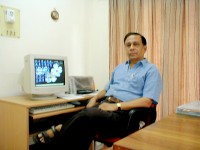
ME AT THE COMPUTER Posted by Hello

Sunday, February 06, 2005

Tuesday, February 01, 2005

THE FIRST INDIAN NEWSPAPER

I was not aware that January 29 was an important day in the history of newspapers of India. According to a recent newspaper article by M. J. Akbar, January 29 is Indian Newspaper Day. On this day in 1780, the first Indian newspaper was published. It was a weekly called Hickey’s Bengal Gazette (aka Calcutta General Advertiser).

The paper’s motto sums up the nature of the media business: “ A Weekly Political & Commercial Paper, Open to all Parties, but Influenced by None.”

James Augustus Hickey, one of the most colourful stars of a resplendent era, launched the Gazette in January, 1780. He became famous for reporting the scandals of his day. His paper’s circulation soared when he reported on the first adultery case to reach the Calcutta High Court. If the laws of libel made it difficult to publish a story, Hickey had no qualms about using transparent pseudonyms like “Hooka Turban” or “Chinsurah Belle.”

The Gazette, however, did not live to celebrate its first birthday. On 14th November, 1780, a diktat was issued by Warren Hastings from Fort William: “Public notice is hereby given that, as a weekly newspaper called the ‘Bengal Gazette” or “Calcutta General Advertiser”, printed by J.A.Hickey, has lately been found to contain several improper paragraphs tending to vilify private characters and to disturb the peace of the Settlement, it is no longer permitted to be circulated through the channel of the General Post Office.”

Hickey responded with fiery rhetoric: “Before he will bow, cringe, or fawn to any of his oppressors … he would compose ballads and sell them through the streets of Calcutta … Shall I tamely submit to the yoke of slavery and wanton oppression? No!”

As M.J.Akbar commented: “And how many journalists have responded in the manner Hickey did? Enough to guarantee the honour of the profession.”

THE REPUBLIC DAY PARADE – 50 YEARS AGO

According to newspaper reports of the time, Republic Day was celebrated in much the same way as it is today. On 26th January, 1955, the President, Dr. Rajendra Prasad, took the salute at a march past of troops, workers and school children on Delhi’s Rajpath (‘Kingsway’ in colonial times).

In those days, there was no particular ‘Chief Guest’ as is the custom today. However, there were prominent invitees who sat next to the President during the ceremonial parade. In 1955, the most prominent guest of the Government of India was the Governor-General of Pakistan, Mr. Ghulam Mohammed! I don’t think there have been any invited VIP’s from Pakistan since then (I am open to correction).

Later, at a state banquet held in his honour, the Governor-General said: ‘ Let us put an end to our disputes. We owe this as a duty to posterity not to leave them a legacy of misunderstanding and bitterness. There is no alternative to the two countries acting in a spirit of truth and sincerity without which it seems difficult for them to achieve real prosperity.’

Sounds familiar, doesn’t it? It might have been an extract from a speech of one of the politicians of today. Things really haven’t changed much in the half century that has passed since Mr. Ghulam Mohammed spoke those words. Where did we go wrong? Perhaps the time has come to invite Gen. Musharraf to be the Chief Guest at the next Republic Day parade!


Sunday, January 16, 2005

OUR FRIEND THE EARTHWORM


DAHLIA GROWN USING VERMICOMPOST Posted by Hello

Last year I became interested in vermicomposting, which simply means the technique of using earthworms to convert various wastes to useful compost (called vermicompost when worms are used) which can be used as a fertilizer. Since I was quite new to this field, I thought I should first talk to some 'experts' in the field. I found, however, that there were as many opinions as there were experts. So my colleagues and I decided to strike out on our own. We started out by using various solid wastes of the paper industry (that is where I work). The worms seemed to like whatever we gave them and they produced what turned out to be very good fertilizer. The picture of the Dahlia above speaks for itself. Other flowers grown with good results were Marigold, Aster and Flox. We have found that this vermicompost seems to accelerate budding and flowering in these plants whereas conventional fertilizers like urea produce more vegetative growth but the flowering is comparatively late.

We are now making plans to expand our working to produce more vermicompost from waste. The lowly earthworm has turned out to be nature's fertilizer factory. The compost produced can be sold should we wish to go commercial. We are happy to have produced a value added product from waste materials.

Tuesday, January 11, 2005

MISCELLANY

BOSTON, USA

Not many are aware that there are 16 towns called ‘Boston’ in the United States. For the uninitiated, these are located in the states of New York, Virginia, Tennessee, Ohio, Montana, Missouri, Louisiana, Kentucky, Connecticut, Arkansas, Alabama, Texas, Georgia, Pennsylvania, and Indiana. Oh! I almost forgot. There’s one in Massachusetts as well.

Also, there is a Boston in England, perhaps the granddaddy of all the Bostons in the USA.

RAIL TRAVEL IN INDIA - 50 YEARS AGO

The younger generation in India today may not be aware that, at the time of independence, there were four classes of travel in the Indian railway system. These were First, Second, Inter and Third. There was a strict caste system in place, the lower class passengers being made to use different entrances and exits from the upper class ones.

The Indian Railways decided to provide sleeping berths to third class passengers for the first time in September, 1954. Before taking this decision, the Government sent a three-man delegation on a two-month study tour of European railway systems. Based on their recommendations, sleepers were first introduced on long distance trains.

Another decision taken by the railways at about the same time was the abolition of separate entrances and exits at railway stations for third and upper class passengers.


Wednesday, November 24, 2004

OUR GIFT TO THE US SENATE

On November 17, 1954, the Indian Vice President, Dr. S. Radhakrishnan, presented an ivory gavel to Mr. Richard Nixon, Vice President, to replace the gavel damaged sometime ago. The ivory gavel was meant for the use of Mr. Nixon in the Senate, where he was the presiding officer. After a brief presentation ceremony, Mr. Nixon entertained Dr. Radhakrishnan to lunch.

In thanking the Indian V.P., Mr. Nixon said that the old gavel used in the Senate from the beginning of the Republic had begun to fall apart in recent years. It was made of ivory with silver caps at both ends. Senate officials seeking to replace it found that they could not obtain a sufficiently large piece of solid ivory and turned to the Indian Embasy for help.

The above news item from 1954 was recently found in The Hindu newspaper. I wonder if that gavel still exists. I am afraid it will now be impossible for us to replace with the ban on ivory use/trading. So the Yanks should take good care of it !

Saturday, June 26, 2004

HUMOUR IN UNLIKELY PLACES

Last year, someone gifted me a subscription to the magazine Prabuddha Bharata, which is a journal founded by no less a person than Swami Vivekananda in 1896 and is published monthly by the Ramakrishna Order. It is a journal devoted to spreading the message of Vedanta and is published every month with learned articles on various aspects of the Hindu faith. Being the serious, scholarly journal that it is, I was pleasantly surprised to find that some of the issues contained jokes and funny stories, with or without a spiritual message, perhaps to offer light relief to the readers! This was the last place I expected to find jokes. However, I think it is a very good idea and I thank the Swamiji who was responsible. May his tribe increase!

Here are two examples from the June, 2004 issue of the Prabuddha Bharata to show the reader what I mean:

1. INTERESTING READING

Aoccdrnig to rseaerch cndoucetd at Cmabrigde Uinervtisy, it deosn’t mttaer in what oredr the ltteers in a wrod are ; the olny iprmoatnt tihng is taht the frist and lsat ltteers be at the rghit pclae. The rset can be a tatol mses and you can sitll raed it wouthit a porbelm. Tihs is bcuseae the huamn mnid deos not raed ervey lteter by istlef, but the wrod as a wlohe.

Amzanig, huh ?

2. THE DIVE

A young man who had been raised as an atheist was training to be an Olympic diver. The only religious influence in his life came from his outspoken Christian friend. The young diver never really paid much attention to his friend’s sermons, but he heard them often.

One night the diver went to the indoor pool at the college he attended. The lights were all off, but as the pool had big skylights and the moon was bright, there was plenty of light to practise by.

The young man climbed up to the highest diving board. As he turned his back to the pool standing on the edge of the board and extended his arms, he saw his shadow on the wall.

The shadow of his body was in the shape of a cross.

Instead of diving, he knelt down and finally asked God to come into his life.

As the young man stood on the diving board, a maintenance man walked in and turned on the lights.

The pool had been drained for repairs.


Sunday, June 06, 2004

A QUACK QUACK HERE & A QUACK QUACK THERE …..

An interesting news item datelined London, June 4, 2004 and published in the Hindu dated June 5, 2004, says that British ducks have been found to have regional accents.

Researchers have discovered that ducks in London have a rougher and louder accent call than their West Country counterparts.

Cockney ducks have developed loud and “shriekier” quacks because of competing noises of city life like sirens, horns, trains and traffic but their laidback friends in Cornwall have softer accent calls.

Victoria de Rijke made the discovery after ducks were recorded at Spitalfields City Farm, East London and Trerieve Farm in Downderry, Cornwall. The quacks were analysed and compared with the help of special computer software.

“We found definite regional differences. The Cockney ducks were much louder and vocally excitable. The Cornish ducks made longer and more relaxed sounds – they were much more chilled out. The Cockney quack is like a shout and a laugh whereas Cornish ducks sound more like they are giggling,” Dr. Rijke said.

“Ideally, I would like to continue this theme and study Geordie, Scouse and even Irish ducks to see the differences in their sounds,” added Dr. Rijke.


A MESSAGE FROM THE GITA

I recently started reading a 3-volume commentary on the Bhagavad Gita, the first among the scriptures of the Hindus. The commentary is written by Swami Ranganathananda, the current President of the Ramakrishna Mission. The erudition and scholarship of Swamiji is well known and I am really looking forward to reading his work.

However, his 68-page introduction itself was so informative and comprehensive that I found it difficult to move on. I had to go back and read it again, more slowly than the first time. I found a wealth of information in this introduction to the Gita, some of which I would like to share with people who take time out to read this.

Although the Gita is perhaps the holiest book of the Hindus, it might surprise many to know that it was not written for any particular religion or ethnic group. It talks about an eternal religion or Sanatana Dharma, which is meant for all mankind. Originally written in Sanskrit, it was included as a part of the great Indian epic, the Mahabharata. The subject of the Gita is a dialogue between Krishna, who is an incarnation of God and Arjuna, a mortal, on the battlefield of Kurukshetra.

The Gita, says Swamiji, was first translated into English by Sir Charles Wilkins and published by the British East India Company, with an introduction by none other than Warren Hastings, the first British Governor General of India, in which we find the following prophetic sentence :

“the writers of the Indian philosophies will survive when the British Dominion in India shall long have ceased to exist, and the sources which it yielded of wealth and power are lost to remembrance.”

The Gita has influenced many people in the western world. Some prominent names in this connection are Sir Edwin Arnold (who also rendered the Gita in English, calling it “The Song Celestial”), Thomas Carlyle, both of England, and also Emerson, Whitman and Thoreau of the USA.

As mentioned by Swami Ranganathananda, the dharma or philosophy taught in the Gita is of a twofold nature, charcterised by pravritti, outward action, and nivritti, inward contemplation. Both action and meditation are needed for balanced development of a human being. Today, there seems to be more stress on pravritti all around us and no emphasis on nivritti. It is work, work and work, accumulate more and more wealth and achieve all the comforts and a variety of pleasures that money can buy. Yet there is no peace of mind and life is full of tensions. The German philosopher Schopenhauer said : “When men achieve security and welfare, now that they have solved all other problems, they become a problem to themselves.”

This unhappiness comes because we only look outwards and not inwards. We do not try to know our true Self, that spark of Divinity that is present in all of us. Our centre of gravity has always been outside. This can be avoided when we add that second value to human life, namely nivritti (meditation) through which one comes in touch with the ever-present divine within.

The combination of pravritti and nivritti is the great teaching of the Gita. This is a philosophy which makes for total human development. This message is not only for Hindus or Indians but for all humanity. That is its universality.

I leave you with that thought. I will now return to Krishna and Arjuna on the great battlefield of Kurukshetra, that is, if I can get past the introduction of Swamiji without stopping to read it again.


Tuesday, May 25, 2004

WHAT JOY !

Great news. My son Ujjwal got his first promotion today. He has become a Senior Manager in his company. He called me this morning and gave me the good news. Why is it that the success of our offspring always brings more joy then our own elevation? It’s a great feeling, which only a father can understand. Ujjwal has been working very hard although he would never admit it. He is not given to talking about himself. May God bless him and give him more laurels and also mental peace and happiness. That would be a really good combination.


Sunday, May 23, 2004

The Long Hot Summer

I couldn't sleep at all last night. The a.c. packed up in the middle of the night. Even the fan stopped working sometime later as there was a total power failure. The result - no sleep. The day temperatures are hovering in the range of 44-45 C. The nights are not much cooler.

Don't mean to complain but it was unbearably hot. Hope the rains come soon. The monsoon has shown its face down south. I hope it hurries up and comes north as fast as it can.

Closing my first blog on this optimistic note.